Showing posts with label food. Show all posts

Monday, December 17, 2007

Orcharding, or, Greater Field Domination


Soon, poor neglected tree, I will bring you friends!

'Tis the time of year for lots of planning. Right now, I am planning my first orchard.

'Tis true, I have apple, plum, (and one) peach trees extant on this farm already. I've got currants, gooseberries, blueberries and strawberries, and that elusive lingonberry, too. And I am in the Fruit Belt, which means that relying on others' efforts to sustain our fruit habit is actually a very inexpensive endeavor: I can get bushels of fruit for an eighth of what you all are paying for it, or less, with no exaggeration.

So I will let the Fruit Belt sustain us with the genus Prunus persica (peaches). Peaches are beautiful but fussy things, well suited to folks with deeper pockets than my own. And I'll look elsewhere for blueberries, though we have them too here on the farm; for vast quantities, I easily can just go to a friend's farm, or, if lazy, I will go to the fruitstand and shell out a whopping $18 for 10 pounds. Yea, people: behold, the Promised Land of fruit production.

(I once went apple searching when I lived in Minnesota. They wanted--I shit you not--$48 for a HALF bushel of McIntosh. It was dispiriting, and it factored in to my desire to move here. Apples should not cost $2 per.)

Why plant my own, if not doing so is so cheap? Oh boy, if you have to ask that question, well, you've only started reading this site then. Let's just say I ADORE a challenge, and am very interested in permaculture. So I am platting my land for the fruits of the genus Malus domestica (apples, baby. Lots of apples: twelve varieties to complement my native two). Pears as well: these are always welcome. Oh, and apricots and cherries. These latter fruits are bird-prone, and will be put at the north of the main garden to act as a windbreak, but also to help me keep away the birds. Throwing nets over them will help.

There are also plans for an arbor of just hops. (Beer.)

Of course, I am looking long-range: I won't harvest my first apple until probably 2010. Do I mind this? No, I do not. My first pawpaw will be harvested in 2019! My first wine grapes (the ones I planted in 2005) in 2009! In other words, if you're planning an orchard, you are planning to stay put and, uh, put down roots.

Thursday, December 13, 2007

On seasonal food preferences


Big bowl of yum

When the days start getting shorter, I notice lots of changes in my habits. I'd like to think that moving to a farm and actually being outside for some period of time every day has tuned me in more to the tilt of the planet, but I think it's more ingrained than that. I think it's biological in nature. Evolutionary biology, to be exact. Bear with me here. As far as I can trace them, my forebears came from either Ireland or France (and many more from the former than the latter). Both of these places see lots less light at this time of year than my little farm does, which, latitude-wise, is as far south as Rome. I have no known biological ties to Russia, but that is where my thoughts go at this time of year.

It is usually in November that I pick up a particularly long book to read, sometimes Russian; this year it's the Oxford imprint (Maude translation) of War and Peace. Maybe it's the early, Doctor Zhivago-inspired visions I had of an icy dacha, but I adore the good long slog in a sledge that a Russian novel reliably provides me at this time of year. It's colder there than here, I tell myself, and darker too. So I tend to put the child to bed and then climb into bed myself, armed with my book, quite early in the evening.

And it is this time of year that, if given the choice, I will always choose a starch over any other food form. Bread, yes, of course; but also potatoes and (xoxoxo) beets, as I love them so. So I read an article like this one with interest: perhaps starch is just something I have been adapted to crave to, uh, tide me over until spring comes again. It's a nice rationalization, really, as I grab my third beet of the week (and these the size of grapefruit).

But think about it. What DID people eat three hundred years ago to sustain them through a long winter? (In places where winter is an issue, that is.) And the answer, reliably, is starch: starch in the forms of roots like rutabagas, turnips, and sugarbeets. And potatoes, that new world wonder.

So bring on the borscht, baby.

Friday, December 07, 2007

This really should just be a garden blog...


Not edible, but pretty

...but I seem to have other food-related interests, though, especially during the non-food-growing winter months. Could it be I simply have more time on my hands?

Anyway, I thought I would share some "food activist" things I have been doing.

My daughter goes to a private school. There is no lunch program, so lunches are up to a child's caregivers, but snack (yes, snack) is up to the school. Last year and the year before that, I worked with a friend of mine to do an organic box scheme wherein we got lots of California veggies and fruits and sold them, in boxes, to some interested families in the school two times a month. This was fun, but...let's face it, it wasn't local, so I felt pretty guilty about those boxes. Our reason for doing was twofold: any profit we made went right back into the snack program, AND our buying power enabled us to buy the kids lots of wonderful fresh fruit and veggies for their midmorning snack.

So this year, well, we kind of dropped the ball by dropping the box (scheme). And now? Now the kids get things like knockoff Chex mix for snack. Chex mix, and #10 cans of pears. (Egads, how far we have fallen.)

This made us a little angry. We're now back at it, this time by starting a Slow Food Convivium that is centered in the school itself. It seems there is a convivium already in our area, and that it was actually the first one in the U.S., but their mission (dinners and wine) and ours (child/parent nutritional education) is different. So, starting in January, we'll be doing Slow Snack two days a week.

Another thing I have recently done is start a buyers' club. A local buyers' club! One of the places we get things from is a new co-op in Grand Rapids. It is a virtual farmers' market: there is NO bricks-and-mortar store. Monthly, members simply order their items online and then pick them up about a week later at a warehouse. This co-op is fascinating, as it is ONLY LOCAL ITEMS from local farmers; grass-fed meats, organic veggies and fruits, home products, knitted goods, soaps... And, get this: they thought I lived too far away!!! So I said the magic word ("buyers' club") and bingo, I am now a member. I place orders with 4-5 of my friends.

Other places we're getting our goodies from are an organic farm near Lansing that mills their own grains, grows their own beans, etc. (They have been my primary source for flour for a while now.) We can still use our California organics source for things like kiwi, avocados, and citrus fruits. And we also "know a guy" (always helpful) who roasts coffee as a hobby, and is able to get fair-trade organic coffee at the fairly traded price, thus charging us only $6 a pound.

Again, my point in telling you all this is to give you some ideas. Child nutrition is a no-brainer in my mind. That my child doesn't know what a marshmallow or a hotdog are is something I'm proud of, frankly. And as for the buyers' club, it helps to pool resources, I think, as there's lots more purchasing power in big orders. (By getting flour delivered to my house in hundreds of pounds, for example, I am able to save big bucks than if I only bought 25 pounds of the stuff.) And as you all know, I think food is very, very important: especially good food. So I put my money where my mouth is.

Tuesday, December 04, 2007

On eating local in a Michigan December


I'm so pretty: Treviso-type radicchio in the cold, cold ground

Remember One Local Summer? Well, one brave soul decided to continue the idea of producing, eating and then posting one locally sourced dinner per week over the course of the winter. Laura at Urban Hennery has found more willing folks who are also giving it a try: go check out the Dark Days Eat Local Challenge.

I did not do this challenge. My reason for withholding is simple: with all food in our larder locally produced, there isn't much of a challenge to be had. This sounds like bragging. It's not: it's just me being single-minded. Admittedly, I thought ahead; this wasn't something I just started to do. I just wanted to show you that, with a little forethought, you might be able to do the same.

My weekly meals rely fairly heavily on making fresh, filling breadstuffs, and on the contents of our freezer/root cellar/canned goods. Lunches are usually leftover dinner. I try hard to mix up the vegetable offerings, but mostly I use up what is fresh first before moving into the deep freeze stash of last summer's veggies. Most of our salads nowadays are fruit-focused, with lots of apples and pears mixing it up with the heartier cabbages, fennel, celeriac and radicchio fresh out of the gardens.

So here's a sample of this week's local eating at Chez El.

Sunday:
Eggs and toast for brunch, with jam (strawberry or Damson plum this week)
Dinner (with company!) of minestrone soup, frozen from August's beany bounty; roast chicken with potatoes and carrots in the roasting pan; roasted beets; oaty whole-wheat bread and a fennel/bosc pear salad

Monday:
Oatmeal for breakfast with applesauce for the sweetener
Lunch of either a cheese or chicken sandwich on the oaty bread; apple
Dinner of biscuits and gravy (with pan drippings from Sunday's chicken dinner, as well as a few pulls of leg meat in there too) with a salad of "hot" coleslaw (think warmed spinach salad); dessert of cranberry muffins (10 lbs. of cranberries from Thanksgiving: luckily, we like them! I've frozen them in 2-cup portions)

Tuesday:
Breakfast of cranberry muffins and applesauce
Lunch of biscuits/honey, fruit, and cheese
Dinner of Michigan-made spaghetti and a jar of tomato sauce

Wednesday:
Eggs and toast for breakfast
Leftover spaghetti for lunch with apple or pear
Soup night: either something with the stock made from Sunday's chicken or potato/leek or potato/kale soup. New whole-wheat loaf, salad from the greenhouse.

Thursday:
Eggs and toast for breakfast, with jam
Lunch of leftover soup, cranberry muffin and apple
Dinner of vegetarian chili with cornbread: my beans, peppers, tomatoes; local Bloody Butcher cornmeal; canned peaches for dessert

Friday:
Cornbread with honey and homemade yogurt with fruit for breakfast
Cheese sandwich or leftover chili for lunch with yogurt/apple for dessert
Dinner of root mashers with steamed cabbage thrown in: think Colcannon without the cheese; salad of shaved celeriac and apple; toast with butter

Saturday:
Porridge (5-grain) for breakfast with fruit
Quick soup for lunch (either out of the freezer or off the shelves downstairs: tomato, eggplant/tomato, or something bean-y) with bread
Dinner of leftover lunch soup, herbed omelet, pan-roasted potatoes, roasted cauliflower; apple tart for dessert

What this weekly sampling kind of tells you is we've got lots of variety. Olive oil and butter are my big out-of-foodshed weaknesses, but lately, I have found a local source for soybean oil, and it is okay, especially for baking. The spaghetti and the cheese were the only things I purchased that were "ready-made," all else is just stuff I chop up and have either cooked and canned/frozen earlier, or am chopping and cooking for the day. Bread gets made about 3-4 times a week, with quickbreads like biscuits or cornbread filling in the gaps. I am not a maniacal breadmaker, though; I often rely on some slow-rising sourdough or a variant of the no-knead method. We free-range on apples and pears in the winter; our root cellar is fairly full of these fruits now. Not much goes to waste, certainly. The chicken carcass always becomes soup or stock, cooking all night and then refrigerated in the morning to be picked over later. The stock is usually then frozen with the meat, sometimes without, it just depends. I also am VERY stingy with the greenhouse greens! Those babies need to grow a bit so January and February aren't so dire. I am also, for some unknown reason, saving all my winter squash. Maybe it's because I am the only one who really truly loves it in the household...who knows.

If this helps just one person think about how he or she can eat closer to home, I will feel gratified. And if anyone would like my sources or recipes, please let me know. Local winter eating can be done, and I swear it doesn't have to be boring!

(Luckily, though, we do like pears and apples.)

Monday, December 03, 2007

Thoughts for Monday

For $1.98 per seed pack, these too can be yours!

"Eat responsibly. [E]ating is an agricultural act....(consumers of food) must understand that eating takes place inescapably in the world, that it is inescapably an agricultural act, and that how we eat determines, to a considerable extent, how the world is used.... This is a simple way of describing a relationship that is inexpressibly complex. To eat responsibly is to understand and enact, so far as one can, this complex relationship."*

Wanna commit an agricultural act of your own? Our mailbox has already seen a couple of seed catalogs this year. When they arrive at your place, do a little bookmarking, and do a bit more mental gardening for next year: how about more vegetables? It will be so fun, and so very good to eat! And, well, it might just make you feel a bit more connected with your world.

*What Are People For? by Wendell Berry (New York: North Point Press, 1990)

Friday, November 23, 2007

100 Mile Thanksgiving (burp)

Whee! Loosen that belt!

--Roasted butternut squash soup (my squash, veg stock, nonlocal butter and curry powder)
--Salad from the greenhouse and what is still out there in the snow
--20.75 lb. hen turkey from Providence Farms, roasted with home herbs under her skin (parsley, rosemary, winter savory, thyme and sage)
--Giblet gravy with a white wine reduction
--Mashed homegrown Russet potatoes with homemade yogurt and nonlocal butter
--Stuffing, both in and out of the bird, with my usual bread and cornbread and celery from here; onions, parsley, sage, thyme homegrown; Maldon salt and homemade vegetable stock
--Brussels sprouts: my two, plus one more stalk from Eaters' Guild
--Roasted root veggies: my few cute sweet potatoes, fennel, turnips and small white onions in a balsamic glaze
--Mashed rutabagas at my mother's insistence
--Caramelized local chestnuts
--Corn spoon bread with local corn (canned by me in August) and Bloody Butcher cornmeal from here; eggs from our girls, veg stock from home
--Cranberry sauce with sugar from the Thumb (+100 miles, but Michigan grown!)
--Applesauce from our trees and that Thumb sugar
--Pumpkin pie and an apple pie (homegrown pumpkins and apples) with flour from here and nonlocal butter in the crust.
--Local wine and homegrown grape juice for toasting

We had eight people, and today we've not got a lot of leftovers, except that huge turkey, which is today destined for sandwiches and soup.

I feel rather pleased that I was able to provide all the vegetables except two. Next year, we are venturing into Turkey Land ourselves (and some meat chickens, too) so I will hopefully be able to reduce the food miles even more. And I keep threatening to get a milk cow for that demon butter I am so very fond of, but that's just me dreaming.

I hope you all had a wonderful, delightful, thankful holiday.

Thursday, November 15, 2007

One week countdown

Thank you NYTimes

Anyone else out there experiencing a tiny bit of pre-Thanksgiving panic?

I guess it started on Tuesday night, when my mother came over for dinner. She began to grill me (lightly) about what she can do, what the menu was, what I had in the garden or in storage that she could take home with her that night to make ahead: I blanched. "I haven't gone down that path yet," I told her after I could breathe normally again.

You see, for we non-religious types, Thanksgiving is a high holiday. Scratch that: it is THE high holiday, as it celebrates food and companionship above all else. Last year, I did the 100-Mile Thanksgiving, and it was quite fun, quite festive, quite a bit of work on my part...but according to our guests, it was also quite tasty. This year I expect the same. Our one exception to the 100 miles is (as ever) butter.

So it is a week away, and I have begun my planning. We pick up our bird on Saturday; she is not a heritage breed, though next year our meat friends have conservancy on their agenda. I have found a new farm for flour and cornmeal. Wine and cider come from down the road. Most other things are coming out of the garden. Our few sweet potatoes and Brussels sprouts will be lovingly prepared. I have already begun to cut up, dry, and freeze any leftover bread, biscuits and cornbread we've had for the future stuffing. I even found a source for local cranberries, something that was missing at last year's table.

So, why the panic if I have all the goods? I don't know. Maybe because I have to work on Wednesday!

Tuesday, November 13, 2007

Canning season is finally finished


"Aack, what IS that? You're KILLING me," says Tom, coming down the stairs to the kitchen. I am scraping off the top layer of sauerkraut from the crock in which it had been fermenting.

So that three heads of cabbage that I chopped and salted in late September have yielded six quarts of sauerkraut. Personally, I thought it was a tad salty coming out of the crock, but the canning instructions said to add some fresh water to the warming pot, so actually the kraut is quite tasty. (You heat the kraut to boiling before you ladle it into the waiting canning jars. Then, it's processed in the pressure canner for about 20 minutes at 10 pounds' pressure.) It's crunchy and somewhat briny and definitely has that cabbage stink that makes my husband gag.

Tom, in no uncertain terms, has stated it will not be eaten if it finds its way onto his plate. (He's such an ingrate, isn't he?) But me? I'm a convert! Bring on the stinky stuff!

But gone now, until next year, is the metallic click and tonk of the cooling jars of goodies. Away, downstairs on a high shelf, now sit the ceramic crock, the monster pressure canner, and the small boxes of the screw-down lids. Two of the three food mills, the big water bath canners, and the extra bowls and scrapers too have made the trip downstairs. And do I have enough food, do I think I was successful in putting up enough victuals to feed us? I...do.

I might have to find a way to disguise the sauerkraut, though.

Wednesday, October 03, 2007

Swiss chard


Even if the trees don't cooperate, the Swiss chard will give you a great shot of color.

Autumn is treading very lightly on our little world here. It appears that this year's leaf display will again be very muted. (My indicators are the sassafras: in a good year, these rhizomatous trees will go through the whole hot range of the spectrum. This year, they've slowly slipped into the rusty-plummy range.) The veg garden is still going nuts (the peppers, eggplants and tomatoes have all hit a second wind), and the recent rain has helped the long-neglected perennial beds.

Chard! I am the only person in the house who adores it. It sure is a sight to behold in the garden, though. Last night, I made a stew in which the chard was a key feature. Rich stews and hot bread are a seasonal favorite. (Thanks, Kelly, for the chard reminder.)

Chickpeas and Chard with cilantro and cumin
From Deborah Madison's Vegetarian Suppers
2T olive oil
1/2 t ground cumin or more to taste
1 large onion, finely minced
2 t tomato paste
sea salt and freshly ground pepper to taste
pinch of saffron threads
14 chard leaves and stems
2 garlic cloves
2 15-oz cans chickpeas or 3 cups home-cooked, with some cooking liquid
1 c cilantro leaves
1/4 c parsley leaves

1. Heat 1T+1t of olive oil in a wide skillet; add onion and saffron and cook over med. heat, stirring occasionally, 12-15 mins. Meanwhile, pound garlic and 1/2 t salt with the cilantro and parsley to make a rough paste. When the onions are golden and soft, add the paste to the pan along with the tomato paste and work it in with the onions.
2. Slice the chard leaves off their stems. Put them in a wide pot with 2 cups of water and cook, covered, until wilted and tender, about 5 minutes. Set the leaves aside and reserve the cooking water.
3. Chop the chard stems into dice and drop them into the reserved chard water. Simmer until tender, about 10 minutes, and turn off the heat.
4. Add the chickpeas to the onion with their liquid or 1 cup water or stock. Coarsely chop the chard and add it as well. Simmer for 10 minutes, then add the stems. Taste for salt and pepper. Serve with the remaining oil drizzled over it all.

Monday, October 01, 2007

Thoughts on how far we've come...


...and how far we have yet to go.

So, today is October 1st. Three years ago today we bought this house and came here, with our eight-month-old daughter, directly from the closing, to start to pull up carpeting, shovel out old furniture, and pull down curtains...all to prepare it for the floor refinishers, the electrician and the drywaller. Whew.

I am showing you a picture of the shelves of canned goods. I have a slowly filling root cellar elsewhere, and the chest freezer is nearly full, and there are at least 15 pounds of dried beans that need to be shelled in the potting shed...and the gardens are still full of goodies, including about 100 pounds of potatoes. There's a good three pounds of garlic braided and hanging in the kitchen. My mention of these things is really simply a wrap-up of September's Eat Local Challenge. And I have a long way to go.

But the recent Harvest Moon got me in mind of this whole "eating-in-season" idea. What would the ideal be, I thought to myself. The ideal, of course, is what most everybody has now: the denial of the seasons that our first-world global-access grocery stores offer us. But what would it truly mean, that is, to deny the seasons and STILL do what I am doing on my 100-Foot Diet?

I am going to seriously look into this. I have a feeling the greenhouse will help.

Friday, September 21, 2007

The Return of the Salad


Yay Autumn! Cooler weather means cool salad greens.

I so looked forward to the day that those little seeds would sprout. Tender greens bolt into hot bits of cellulose here usually around the end of June. For years past, I have tried in vain to find something to substitute for those little bites for July-September. Malabar spinach, amaranth, chopped cabbage, some more stalwart Asian mustards...blah! So this year I gave in and went without.

Like awaiting that first tomato, the return of the Salad is something to be savored, to be...celebrated. So we did, last night. Bread, soup and...salad.

And the best part? The kid kept asking for more.

Friday, August 31, 2007

Everyone's got tomato stories...


The turkey roasting pan gets a second use this year

...so I thought I would post a tale too.

I read a lot, and am usually not terribly forgetful about what it is I read, but I am now realizing--a big smacks-forehead moment--that I need to credit someone's writing for many of my recent thoughts. You see, I read this book when it first came out: I got it at the library. I was a city girl at the time, and lived a very organic life in my own small city plot. But somehow, though I loved the book, it didn't stick, at least obviously, in my thinking about my new life here in the country.

But enough of you have either listed this book as a favorite or have simply mentioned it that I actually spent money (!) and bought it. I've been rereading it this week. So when I read things that she says like

"...it is difficult for me to take seriously the question of whether eating locally is worth the trouble. Clearly it is for me. Trying to understand why, I have realized that my own commitment is probably driven by three things. The first is the taste of live food; the second is my relation to frugality; the third is my deep concern about the state of the planet.

As is surely obvious in all I have written to date, the production and consumption of fresh local food is so rich an experience for me that I find it hard to imagine how I would live if I couldn't grow what I eat and eat what I grow."


I say, sing it, sister!

So. No tomato story. How about a tomato thought:

Joan's Tomato Glut Sauce
(adapted from the NYTimes)

Preheat oven to 400*.
Put into a large roasting pan:
6 pounds tomatoes (plum are best), cored and quartered
1 1/2 cups coarsely chopped carrots (optional)*
1 1/2 cups coarsely chopped celery (optional)*
1 1/2 cups coarsely chopped onions
9 cloves garlic, coarsely chopped
6 tablespoons balsamic vinegar
1 bay leaf
1 1/2 tablespoons each fresh thyme, oregano, basil, parsley
1 1/2 teaspoons salt...or less
1 tablespoon freshly ground black pepper

Roast 45 minutes, or until veggies are soft. Process briefly to leave slightly chunky, and freeze in 2-cup portions. Makes 2 quarts (4 pounds).

* Very optional. I used pepper, eggplant and yellow squash in mine (it's a color thing) and I used all the tomatoes that happened to be fresh TODAY. It's Glut Sauce, you know...

Sunday, August 26, 2007

Comfort me with apples (and grapes)


It's a decent year for fruit here at Old Vines. We had a killing frost over Easter weekend, which locally did lots of damage to whatever was blossoming at the time. Apricots and plums were mainly affected, the latter here at the farm, too. Last year, frost got our grapes. (It's always something?) What it proves to me is we need to make sure we diversify.

We plan on expanding our orchard significantly this fall. Lots more different kinds of apples, with different bloom times. Other fruit trees, too, will join us: pears, peaches. And the Old Vines of the title of the farm? They'll stay, those 80 year old vines, but maybe I'll invest in some European varieties, too. You know, if I decide to make my own hooch.

Canning season, then, will extend into November! Yum. Grape jam, apple butter, apple sauce...

Friday, August 17, 2007

Words of others

I'm still doing lots of thinking, so instead of going completely dry here on the blog, I thought I would give you an article to read about the Fruit Belt. We live a paltry eight miles to the north of Benton Harbor, and almost every small business around here of longstanding either goes by Blossomtime X or Fruit Belt Y. And yes, I can easily buy cheap produce here...it's one of the reasons we moved!

Wednesday, July 25, 2007

Thinking ahead, part 2


Under pressure (think a crooning Freddy Mercury)

It has been cool. This is a good thing, as I have been doing a lot of canning lately.

I have learned one thing: I should only can the things that we enjoy eating. The logic of this amazingly obvious statement escapes me when I see the myriad fruits and cheap veggies at the local farm stand or --eeps-- in my garden. It'll be January and I realize I am the only person in the household who will eat canned beet greens.

I've learned something else, too. I tend to treat that which is rare as something that is really precious, and thus, not for eating. When I was a city gardener, I remember well my first crop of eggplant. I waited and waited for some sign that dang, I should pick and cook those things, and when that sign finally showed itself the eggplant was seedy and gross. I do this with some canned items, too. There are dilly beans down there from 2005. Eat them, I tell myself. And we have been. When things start getting going in the garden in May and June, it is also the Season For Emptying The Larder, whereby I cook everything in the freezer and pantry.

So! The kitchen is full of glass jars and big kettles at this time of year. We have a pressure canner, too. I have been putting away dried beans in it: making them cooked beans first, or soups. Oh, and vegetable stock. Can't have enough of that. I am rather fortunate in that I work from home most days, so in between phone calls, emails and drawings, I am banging pots on the stove. The convenience of pulling a can of tomatoes and a can of beans and making a quick chili or pasta in the middle of winter makes it worthwhile. And, probably most importantly, I know where the food came from, and how it was prepared. And it's quick, or at least it's quick when they're finished!

Saturday, July 14, 2007

Summer = visitor season


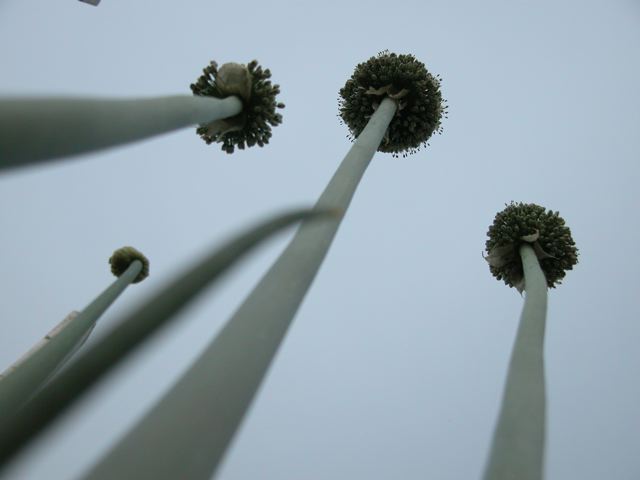
Flowering leek

James Beard once said that, without the allium family, there would be food, but no cuisine.

Maybe it's cuisine we "et" around here, because I have been known to put onions in dessert. And I've got aioli on my mind: it's Bastille Day, after all, and I have lots of new garlic and newly laid eggs. But instead I am making a simple soup of flageolet beans and a ton of things I pulled out of the garden. Maybe some corn, maybe a salad.

I honestly admire people who can think ahead and plan out every meal their family eats. It is not something I can do, though. I honestly don't know "what's for dinner" until I go out and see what's edible. Even with people coming! Some folks just left (having brought some lovely bread and pain chocolat from the city) and more are coming tonight, more tomorrow...it's just GREAT!!!!

Hope everyone else is having a great weekend, too.

Wednesday, July 11, 2007

Boss got you down?


Spouse driving you crazy? Kids? How 'bout this unwinnable war, you know: the one that now costs us OVER $12Billion a month?

NO, I am not talking about the knives. The mortar and pestle! Get them out, get some garlic and some green herbs, and salt, and get POUNDING. Take it from me: it is therapeutic, and oh so tasty.

This lovely pistou went on some spuds last night.

What, you don't have these things growing in your back yard? Well, if you have a particular seller you like at your farmer's market, and you don't see these things, just ask them. Almost all growers have these things for their own use: if you ask nicely, they'll bring you some next week. Believe me, farmer's market folks would love to expand their markets, and with more choice, we'll all benefit!

So get pounding.

Sunday, June 10, 2007

Timing


Takes longer than you think (and another piece of chicken tchotchke has darkened my door)

Timing, or rather the awareness of how long things take, is something I have to relearn every gardening season. The first time I weeded this spring I felt like it took an eternity, and I was *only* doing the herb garden (3'x20'). In actuality, what was happening is I needed to reacquaint myself with the motions. The fine motor skills, the visual assessment (weed? not weed?), and how to move through the bed (front to back? side to side?) all needed to come together. Getting those neural pathways reconnected after months of being idle took longer than I thought.

I wondered if this is what people felt like when they picked up knitting after a long time off.

Other little tasks also take some time adjustment. Do I, for example, have enough time to go pick a salad before that water boils? (No.) How long does it really take to shell enough peas for three people? (Longer than you'd think.) How long will it really take me to weed the onion bed? (How much time do you have?) Now granted, all these tasks are very pleasurable to me. Pea shelling, for example, is really relaxing; you just sit and zip them out. (But then shell bean season comes along and it's not so much fun.)

Timing-wise, there's a bit of longitudinal planning I have to do, too: for example, I know well enough how to succession plant, mainly to avoid the kitchen log jam of "what, green beans AGAIN?" that happens when I plant two varieties too close together, ripening-wise. I wish I could claim that I look at a calendar and count backward from when I plan to eat things, but I don't. It's all a bit of a mix, and when things are ripe, well, there should be no complaints because we're EATING them, again, tonight!

And then there's ripening time, or rather, "the season" for things. We've passed asparagus season and yes indeedy we did eat asparagus every night for about three weeks. Now we're into peas and lettuce, and strawberries. Fava beans will come in before the regular beans, chard before the lettuce bolts, and then from then on it's just absolutely too much of everything around here, so it is time to start freezing and canning. Canning Season. And that takes some timing, some readjustment, too.

And then, after it is all finished, I have the whole winter to dream about doing it all again.

Wednesday, June 06, 2007

Those golf ball-sized things can't compare


Another good forage: this time, it's wild strawberries from the side yard.

(Note to self: if you expect to eat any of these yourself, then don't let the child carry the bucket.)

These were quite lovely over store-bought ice cream last night, and with yogurt and granola (both homemade) this morning.

Tuesday, June 05, 2007

On variety


Purple Sprouting broccoli

One of the disconcerting things about industrial food production is that its methods, above all, are reductive. Go to your local grocery store even during apple season and count the types of apples you find there, for example. Is that number four, or six, or (outlandish) eight? And do you know how many types of apples are out there, fit for human consumption? I can tell you plainly that number is probably closer to eight to the eighth power (i.e., pushing 17 million) than it is to eight.

I mention this because, by growing things from seed or buying saplings from heirloom growers, our household, at least, is not beholden to the limits of Big Ag. We've got five different apple cultivars, and room for many, many more. Perhaps I am a bit of an oddball, but there are five different types of broccoli growing in the spring garden right now. There are six types of garlic, four types of onions, two of scallions and two of shallots, if I were simply to mention the allium family...though I am only growing one form of leek (poor neglected leeks). Each one has its purpose. I like the fact that we mix things up around here, that our biological footprint is a broad one. Like microbes, I appreciate the many.

I mention this likewise because traditional food cultures EXPECTED variety. I have a book that lists the forty-five different types of cabbages that the average French farmer or shopper would know; granted, this book was first published in the 1860s. But really. The world offers much more produce than that found in your local grocery store! Do you crave variety, but don't have five acres? Join a CSA and get it sent to you, support your local growers, or grow your own.