Ick, another bad picture.Robin
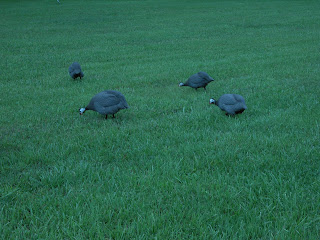
 wanted to learn more about our guineas. I have been thinking I should do a complete post about them, so here it goes.
We decided to get guineas because we lost two hens to a hawk last year. What's the connection? Well, guineas are the Chicken Littles of the farmyard. Anything that flies, drives, or walks by that's out of the ordinary, they start howling. We decided on guineas over a rooster, who'd also watch out for hawks, but...well, I didn't want to risk the idea of getting a "bad" rooster who'd attack our kid. (I also wasn't too hep on having pecked sex-enslaved hens or being awakened by a 2:00 a.m. crowing.)
The guineas, of which there are four (three hens and a cock) are virtually indistinguishable in looks, activity and any other way from each other. They subscribe to a severe case of Group Think so if one of them is doing something, the other three will soon be doing the same. As a farm animal, they haven't been domesticated for long. This near-wildness appealed to me if I had to continue to pen in our birds: I really like seeing the chickens walking around the farm, in pursuit of their chicken-y desires; I figured if the chickens needed to be penned, the guineas, who can fly, would still be free-ranging. Well, let's just say that near-wildness is an acquired taste.
So, the initial reason that we got them remains. They are
excellent watchdogs. They immediately notify the other birds, and the surrounding township, if anything is amiss. On Monday, for example, they were making quite a din and I thought: geez, it's kind of late, aren't those birds in bed yet? And I look out at the side yard and they are yelling at THREE DEER, one with a huge rack on his head. They actually chased the deer, too, once one of them turned and started to run.
Other than that, they lay their eggs in the bushes, what few eggs there are, so...if you expect to get eggs out of these creatures, you really have to work for it. They can sleep in trees, and expect to have a very high perch in the coop. They completely imprinted on the one chicken that looks like them: Letha, the Barred Rock. Anywhere their Mama goes, they go...otherwise, they'll follow Maggie, the Black Australorps or Pauline, the white Leghorn. (Interestingly, they never follow any of the other birds, who're all red or brown: they definitely segregate themselves with the monochrome range of the feather spectrum.) I think it was a good idea to get them and put them with the young chicks we had, as they picked up some but certainly not all of those good chicken traits, like, She is not the enemy; She is the bearer of all good treats. The guineas were the ugliest birds imaginable until they got all their feathers. Now, at least, they are mature: their heads are the only things odd-looking about them.
And from a very young age, they developed the ability to count. If one of them is not with them, they start hollering, trying to find him/her. It's an interesting but annoying talent.
My friend Tim said he ate them a lot when he lived in Italy. He said his Italian friends told him they had them to eat small blood-sucking bugs, of which he never had the English translation. (Ticks. They love ticks.) Supposedly, their meat is great roasted. I guess I will never know. We will keep them for the rest of their happy dopey lives, I think, but...they are just so incredibly loud that I doubt Tom would ever go for getting more of them.
Would I ever get guineas instead of chickens? Not in a million years. Chickens are friendly, egg-laying, happy souls. Guineas have an amazing persecution complex, one that will probably be worn down by another 10,000 of domestication. Don't get them if you have neighbors, period, unless your neighbors have them or their near cousins, peafowl.